Students: know how you learn, then use and abuse it!
Introduction
Often when we think about learning, we think about reading textbooks or listening to someone speak about a specific topic. The teaching methods used are typically visual, auditory, reading-based or kinaesthetic; VARK for short. Words come up on a board, lecturers reel off information, and, for some, our minds start to wander away from the black and white screen or voice of the lecturer. There are various reasons why an individual may struggle to engage with a singular VARK learning style, and also why it is so important to use a selection of styles. Through various research methods, the aim of this blog it to enlighten students to the ways in which people learn; indicating that it’s normal to have a preference to certain styles, it may just involve a little bit of extra work.Through this piece of writing, the credibility of the individual VARK learning methods is questioned. Instead, it is suggested that a mix of all of them has been found to be best. Multimodal learning combines the four modes above to engage with those individuals who struggle to grasp information from a singular mode of education. A video with images, subtitles and sound is a good example of multimodal learning, as it engages several senses at one time. Exploring these ideas, this blog will discuss the different learning methods, and investigate whether or not multimodal learning is the best method of teaching for all. This blog will dissect two of the possible difficulties of this approach to learning; mostly, the generalisation of learning styles, and the societal tendency to link aspects of VARK learning with a particular level of cognitive intelligence.
The Modes
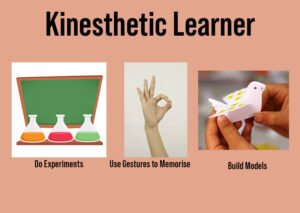
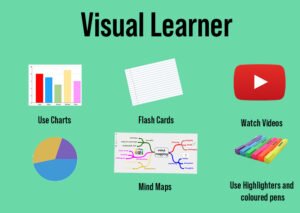
People learn in different ways and often information is taught through a few select techniques, which may prevent certain individuals retaining much of that lesson. VARK is an acronym for this general group of learning modes: visual, auditory, reading and kinaesthetic. This was first detailed by Fleming and Mills in 1992, who updated the original three letter acronym created by Walter B. Barbe in 1979, of VAK, where reading was included under visual. Fleming and Mills thought that reading deserved its own letter as they found many students that he studied had a larger preference for plain writing on a page, rather than diagrams or images. Visual learners are more suited to an accumulation of images, graphs, maps, diagrams. VARK Learning Limited states that: “It must be more than mere words in boxes that would be helpful to those who have a Read/write preference”. Auditory learners take information in from verbal lectures, podcasts and discussions – online learning during the pandemic probably worked a treat for them. The third suggested mode of learning is the “read/write” style, which Fleming and Mills believe is separate from visual, as it is word based and lacks images. The students who prefer this reading/writing mode of learning tend to prefer books to videos, and can take in information from long black and white articles. Last, but not least, we have kinaesthetic learners who need physical objects to hold and make sense of. Kinaesthetic learners need the experience of completing a certain task, or utilising an object, to gain the most valuable form of knowledge for themselves, and often struggle to comprehend information when it isn’t in a real physical form.
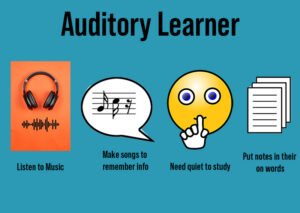
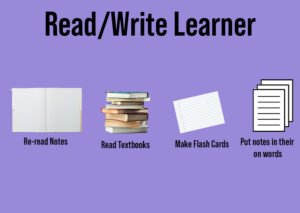
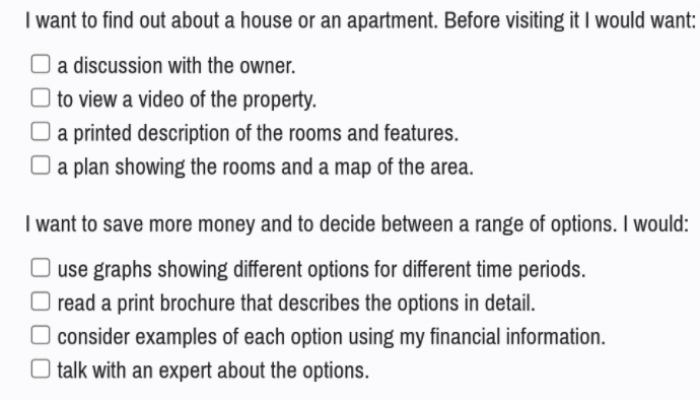
Neil Fleming designed a questionnaire – The VARK Questionnaire- to determine what an individuals’ preferred learning technique is. It asks 16 questions, following similar topics as seen in the image below. There are four possible answers for each question, each answer corresponds to one of the four learning modes. Users can select as many answers that apply. Once the results are in, numbers corresponding to each learning mode let the user know what their preferred method is, or if they are a mix of a few, which is called multimodal. If you want a more detailed report on your learning, you’ll have to pay. Try it out for yourself: VARK Questionnaire
Multimodal Learning
When it comes to learning, the four modes aren’t clear cut for everyone. Granted, some people will have a huge preference for one or the other, but many will have a mix of two or more. This is where multimodal learning comes in. VARK Learn suggests that there are 2 different types of multimodal learners: The first group need specific contexts and tend to switch learning modes depending on the task at hand. They may prefer to physically learn how a spring works, but need an audio book to interpret text, rather than read through articles. The second multimodal type is for people who need an array of all modes to really understand what it is they are trying to learn. They will need a good understanding of the topic before acting upon it, which, in the long term, could make their decision making skills far better than the average Joe. In the VARK questionnaire, if two or more of the modes are near equal numbers, this would define someone as a multimodal learner. If you consider yourself a visual or auditory learner, the explanation of multimodal learning in this video might suit you better.
Fig 10 – Gnowbe (2020)
Dr. Derek Muller, who goes by the name Veritasium on YouTube and has a PhD in physics education research uploaded a video titled “The Biggest Myth in Education”. In this video he asks random people on the street about their learning styles. He goes on to either show them or read out a list of different objects for them to remember. In the video he talks about how multimodal learning is actually proven to be more beneficial to people for learning, he says: “people learn best when they are actively thinking about the material” engaging multiple parts of the brain effectively does this. He goes on to say “… you are all kinds of learners in one. The best learning experiences are those that involve multiple different ways of understanding the same thing”. So although it is fine to have a preference, the best way to learn is through a mix of several styles.
Time & Effort
When it comes to teaching the different modes, many teachers use multimodal learning as it can succeed in engaging everyone in the classroom. A nice analogy here is to consider that multimodal learning gives students an opportunity to try a small bit of many different types of pie (in the hopes that at least one type of pie will appeal to each student), rather than providing only one type of pie that only some students will eat. Of course, it is easier to utilise multiple modes in certain subjects than it is in others. If you are studying graphic communication, for example, the use of images or videos, along with commentary and printouts of text descriptions, are very easy to produce as the subject uses a mix of different media. In addition to being a design-based course, there can be physical aspects to it as well; such as constructing objects or parts. On the other hand, you have mathematics, which is largely reading and writing based. High school and university level maths can get very complicated for some, and the use of images is almost non-existent here; therefore, problematic for those who require visual learning. It can be very time consuming for teachers to include multimodal learning in their classes. For instance, it can be quicker and easier to sit and write out a body of text for students to read off the board, without having to find, and then explain, relevant images, graphs, and experiments. Some would suggest that subjects need to be as multimodal as they possibly can be. Although it can be time consuming for teachers to provide information in multiple modes, the benefits for the students are potentially massive, and will have a lasting effect on their lives. That is the reason teachers want to be teachers in the first place, right? When learning through multiple modes, students may be more likely to retain information for the future, the classroom environment becomes exciting, and morale will be boosted majorly as it is engaging to be there. In a later blog post an interview with my old high school teacher will go into this from the other side giving great insight into the issues that may come up when trying to use several modes of teaching.
Multiple Intelligence
VARK is one of the most well-known outlines of learning styles, but others have built on this and created other versions. One such theory is “Multiple Intelligence” by Howard Gardner who proposes a nine intelligence system. These nine are; Verbal-linguistic, Logical-mathematical, Spatial-visual, Bodily-kinaesthetic, Musical, Interpersonal, Intrapersonal, Naturalist, and Existential. Gardner proposes that everyone has the capacity to understand learning through all nine variations in one way or another. It is important for knowledge to be taught and presented in a way that benefits everyone, in an attempt to increase the capabilities of humanity as a whole. Gardner goes on to say that teaching material in multiple ways not only helps the students understand concepts more easily, but also, that this solidifies the knowledge of the teacher. Multimodal learning in Gardners mind is the best and only way for the next generation of humanity to improve. Gardner’s nine intelligence theory is more complex than Fleming’s VARK. Whilst Fleming champions 4 distinct learning modes, Gardner indicates that intelligence is something far more than the ‘learning styles’ category his work is often mistakenly placed in. He mentions:
“Style refers to the customary way in which an individual approaches a range of materials—for example, a playful or a planful style. Intelligence refers to the computational power of a mental system: for example, a person whose linguistic intelligence is strong is able readily to compute information that involves Language.” (Gardner, 2013)
Therefore, the way someone goes about learning something is a style, but how a person’s brain is wired and rewired to learn and present certain studies is intelligence. Another example Gardner uses is music. He states that although a person can enjoy music, it is totally different from being musically intelligent.
Round Up
The foundations of VARK are an important starting block for the different preferences students and people may have when it comes to studying. The overall idea of VARK was that people learn through four different mediums; visual, auditory, read / write and kinaesthetic. As seen in the modes section, the images show the main media people can use to benefit their preferred learning style. VARK was one of the first understandings of how people learn, and has since been scrutinised and built upon by Gardner and others. Whilst I do agree that people have a preference for styles of learning, I have highlighted that VARK doesn’t describe the way brains actually learn. I will keep these key arguments in mind when I conduct my research in the following blogs. The third blog in this series will touch upon the way the brain works and how that is used for people to recall information.
Next in the Series